


Words without a literal translation that help you understand a country better than a guidebook
26-10-2026
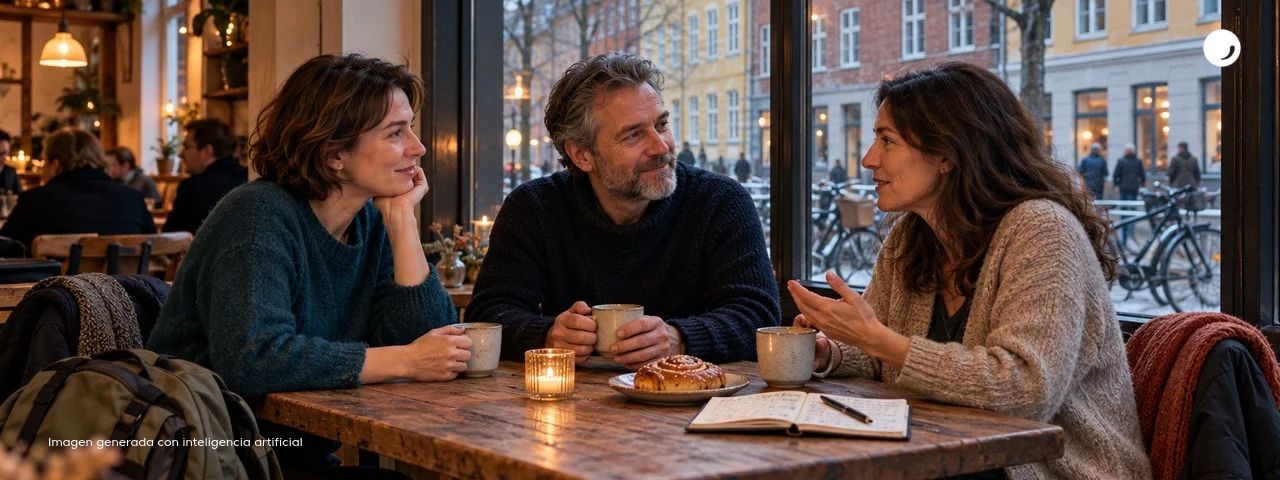
Some words are hard to translate because they pack a feeling, an idea or a way of looking at things unique to a place into very little space. There are plenty of them. As many as there are cultures on the planet. And we’d like to introduce them to you a few at a time because, when you understand them, you also understand the people who use them every day a little better.
Ready for the first batch?
Lekker (Netherlands)
In the Netherlands, there’s a word you’ll hear constantly and which, once you start to understand it, seems to be everywhere: lekker.
At its most basic, it means something like “tasty” or “delicious”, so you can use it to talk about food. Nothing particularly revolutionary so far.
The interesting thing is that the Dutch don’t stop there.
A day can be lekker, a night’s sleep can have been lekker, a plan can sound lekker and someone might even say they’re simply lekker sitting in the sun. In everyday use, the word expresses that something is appealing, inviting, pleasant or simply enjoyable.
And perhaps that’s what makes it interesting: rather than translating it, you need to get a feel for it.
Because after a few days in the Netherlands, hearing lekker everywhere, you start to realise that some words don’t need an exact translation. They just need you to start using them.
Hygge (Denmark)
When you walk into a Copenhagen café on a December afternoon, with freezing air outside, and see tables full of happy people who seem in no hurry to leave, you start to understand it. They’re in hygge mode.
It’s a term you may have heard before, as it’s become very fashionable online lately as shorthand for a cosy blanket and a romantic candle, but its meaning for the Danes goes much deeper.
It describes that warm, shared sense of wellbeing you feel at a simple gathering with people close to you, without any fuss, usually in a cosy setting while it’s cold outside.
It’s no coincidence that the concept is so closely associated with Denmark, a country of long, dark winters: more than a particular style of décor, it’s about finding warmth, company and comfort in everyday life.
Saudade (Portugal)
If you visit Portugal and listen to its fado or look at its art, you quickly pick up on a melancholy note running through everything. It isn’t pure sadness, because there’s affection and a certain beauty in that feeling too. But it’s there. A sense of longing expressed in a language of its own.
Yes, saudade is perhaps one of the most famous untranslatable words, and with good reason: it describes a deep longing for something or someone you love, mixed with a sense of absence and the possibility that they may never return. Portugal resonates on a unique emotional frequency.
Komorebi (Japan)
Komorebi describes sunlight filtering through the leaves of trees, creating patterns of shadow and glimmers of light.
There’s no equivalent word in English for something so specific, and that’s precisely part of its charm: giving a name to a scene you’ve probably seen hundreds of times without thinking it needed one.
Trust us: walking through a Japanese forest with this word in mind changes the way you look up a little.
Fernweh (Germany)
Fernweh, literally “the pain of distance”, describes an intense desire to be far away, anywhere other than where you are right now.
It’s the perfect term for that restlessness that suddenly appears when you’re looking at a map or photos of another city: the urge to go somewhere, with no particular destination in mind yet, just the certainty that you’d like to be somewhere else.
How many trips must have started exactly like that, long before we knew there was a word for it?
Hiraeth (Wales)
The Welsh word hiraeth resembles the Portuguese saudade, but has a nuance of its own: it expresses longing for a home you may no longer be able to return to, because it has changed, because it no longer exists as you remember it or even because it never existed quite as you yearn for it.
It’s a term deeply connected to the Welsh language and cultural identity. Knowing it adds another layer to understanding a place where the relationship with the land, language and memory carries particular weight.
Meraki (Greece)
A Greek person doesn’t cook for you just for the sake of it. Nor do they approach a craft any old way. There’s always, or almost always, a great deal of care in what they do: it’s what they call meraki, doing things with soul, with special dedication and care, putting something of yourself into the result.
Go and see the remains of Ancient Greece. Look at the columns. The carvings. You’ll see meraki in every one of them. Not just in the result: the concept reminds us that things are also measured by the care behind them.
What all these words have in common
None of these terms was created as a tourist export or to decorate a breakfast mug. They came into being because a language needed to name something that occurred often enough to deserve a word of its own.
And that’s why, when you travel somewhere and learn one of these words, you’re not just learning vocabulary: you’re discovering a small piece of how people there talk about life, time, distance, affection or the things that simply feel good.
You’re understanding the place you’re visiting a little better. And that’s pretty cool.
Do you know a word with no exact translation that should be in the next batch?
Reserve your Parking

Barcelona El Prat Airport Parking
→ View parking
Barcelona Sants Train Station Parking
→ View parking
Madrid Barajas Airport Parking
→ View parkingShare article