


5 routes where it’s worth comparing trains and planes
27-10-2026
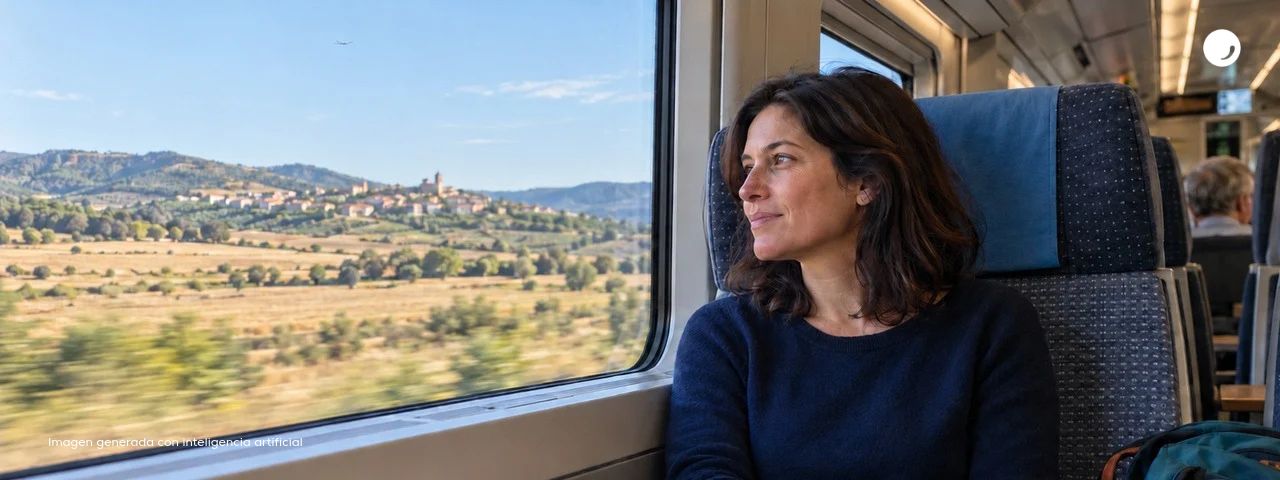
There’s a little catch when people say a flight “takes an hour”. The plane does. You don’t.
You have to get to the airport, park (though with aparca&go, that part is already sorted), go through security, find your boarding gate, check that it’s still the same boarding gate, wait, fly, land and, once you’re there, work out how to get from the airport to the place you actually wanted to go.
Suddenly, that one-hour flight starts to come with quite a few asterisks.
And that’s where the train comes in.
Because on some routes, even if it looks slower on paper, once you do the sums properly it can turn out to be much more practical. And, in some cases, even quicker. Want some examples? Here are a few of the standouts:
Madrid–Seville: the original AVE. There’s a reason for that
Spain’s first AVE linked Madrid and Seville in 1992 and, more than three decades later, it’s still one of the best examples of trains getting the better of planes. The fastest trains cover the journey in around two hours and a quarter and drop you at Santa Justa, a short stroll from central Seville.
The airport, on the other hand, is about ten kilometres outside the city, so you can easily add another 30 to 45 minutes of travel to your flight time. And that’s after going through the whole pre-flight airport ritual. Security check included, of course. Nobody gets out of taking their belt off that easily.
Here, the train has a major advantage: you leave from practically the centre of Madrid and arrive in practically the centre of Seville. Fewer detours. Less hassle. Just how we like it at aparca&go.
Madrid–Zaragoza: the journey that feels like a miscalculation
There’s something slightly bewildering about Madrid–Zaragoza. You get on the train, settle in, perhaps answer a couple of emails, look out of the window for a while and, before you know it, you’re in Zaragoza.
Getting from Madrid to Zaragoza in just over an hour and twenty minutes is, quite simply, one of the best returns on travel time anywhere in Spain. For this distance, it doesn’t even make sense to consider flying. In fact, it’s one of Madrid residents’ favourite destinations for a day trip, something that would be unthinkable by plane. And Zaragoza, in case you didn’t know, is one of the country’s largest and most iconic cities.
Madrid–Santiago: when looking out of the window is part of the journey
If you want to get there as quickly as possible, the train probably isn’t your best option. But if you’re in no rush, there’s another way to measure this journey.
On some routes, the window is basically there to check whether it’s still daylight. And then there’s the journey to Galicia.
Travelling from Madrid, you leave the central plateau behind and gradually enter a greener, more rugged landscape, with hills, valleys and towering viaducts that make looking out of the window rather more interesting than usual.
The train doesn’t just have the advantage of taking you straight into Santiago. It also lets you watch the scenery change as you go.
It’s not that there aren’t great views from a plane — there are, and some are hard to beat — but the experience is different.
It won’t be the deciding factor for everyone.
But if you have the time, this is one of those routes where it’s worth taking a window seat and letting the journey become part of the destination.
Barcelona–Valencia: when you need to do the sums properly
Here, the comparison isn’t quite so obvious. The train takes around three hours, while the flight takes just over one. If we only look at those two figures, the winner seems fairly clear.
But this is precisely the kind of route where it pays to look beyond the journey time alone.
The train leaves from Sants, within Barcelona, and arrives at Joaquín Sorolla, also within Valencia. If you fly, though, you also have to factor in the time either side of the flight itself, as well as the journey from Valencia airport into the city.
And that’s when the gap starts to shrink.
It’s a similar story between Madrid and Valencia: the flight takes around an hour, but high-speed trains connect the two cities in roughly two hours.
Does that mean the train always wins? Not necessarily.
It can depend on the timetable, the price, exactly where you’re setting off from or even how much luggage you’re taking.
But this is precisely one of those routes where it’s worth adding everything up before you decide.
Madrid–Barcelona: the historic rivalry
If there’s one route in Spain where trains and planes have been going head-to-head for years, this is it.
Madrid–Barcelona has long been one of the great showcases for high-speed rail: for years, the fastest services covered the journey in around two and a half hours. Now it’s a slightly closer contest. Following the inspections and speed restrictions introduced across the network during 2026, many journeys are closer to three hours. Flying, meanwhile, still takes around an hour and twenty minutes in the air. The answer here is no longer quite so clear-cut.
The train connects Atocha and Sants; flying can still be competitive depending on the timetable, the price or where your journey actually starts.
Who wins? It depends.
Perhaps that’s why this remains the great classic of Spanish travel. There’s no universal winner. You need to do the sums.
So, when is the train really worth it?
After all that, the conclusion might be less clear-cut than you expected.
And that’s a good sign.
Because the train doesn’t always win. Neither does the plane.
It depends on the distance, where the stations and airports are, the timetable, the price, your luggage and how much you value arriving straight into the city centre.
But there’s a fairly useful rule: the shorter the journey and the more extra travel flying involves, the more it’s worth comparing.
And then there’s a factor that rarely appears on comparison sites: stress.
Arriving at a train station fifteen minutes before departure can be perfectly reasonable. Trying the same thing with a plane is a fairly effective way to find out your maximum heart rate.
Ultimately, it’s not about always choosing trains or always choosing planes. It’s about choosing what makes most sense for each trip.
And however you travel, there’s one part you can simplify: parking.
If you’re flying from Barcelona or Madrid, you can book your space with aparca&go and arrive knowing your car already has a spot.
And if, after doing all those sums, you decide the train wins this time: we’re also at Sants, Atocha and Chamartín.
Because we can’t shorten your journey. But we can help it start with less driving around.
Reserve your Parking

Madrid Barajas Airport Parking
→ View parkingShare article