


Atocha or Chamartín: the guide to avoiding a last-minute dash
30-09-2026
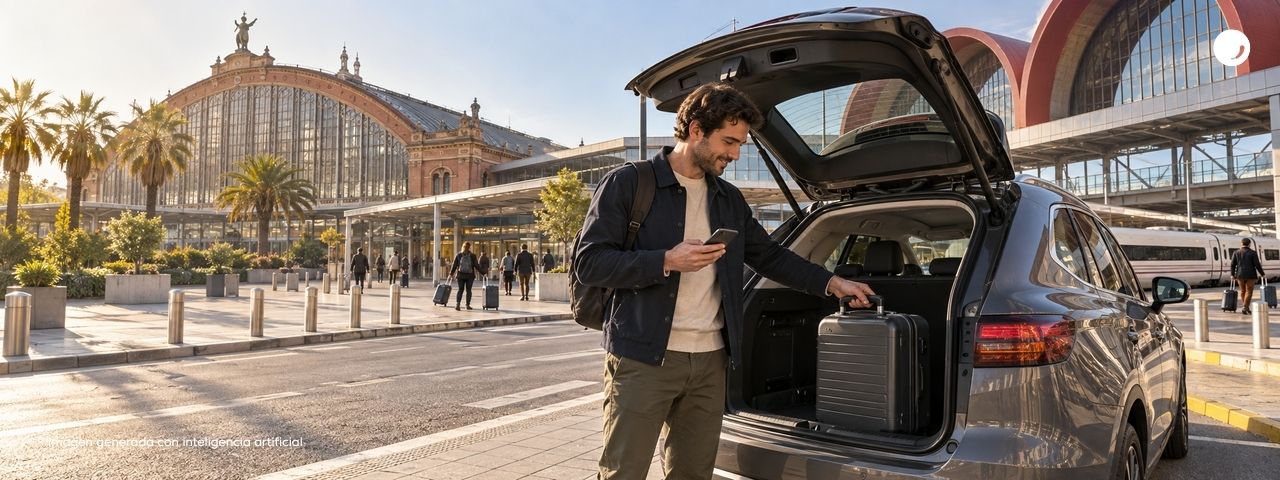
We all have that friend who has turned up at Chamartín with a ticket for Atocha. Or the other way around. They tell it as a funny story over dinner, but at the time there is nothing funny about it: suitcase in hand, clock ticking and thirteen minutes on the commuter train ahead of you that, when the doors close in five, feel like the countdown in a bomb scene.
The good news is that avoiding it is easier than it looks, because Atocha and Chamartín do not divide up their trains at random. Once you know it, the geographical logic is very clear: each station mainly handles trains heading towards a different part of the map. The less good news is that, if you are driving, each station comes with its own traffic and parking traps. Let’s take it step by step, no rush (we’ll save that for the platform).
Which station you need depending on your destination
Atocha —officially Madrid Puerta de Atocha-Almudena Grandes— covers the south, east and north-east: Barcelona, Valencia, Alicante, Zaragoza, Toledo, Seville, Málaga, Córdoba… If you are heading to Algeciras and you are standing in Chamartín, you might want to start running. It is also, as an extra bit of useful information, the larger and busier of the two stations. Keep that in mind when planning your time.
Chamartín —Madrid Chamartín-Clara Campoamor— covers the north and north-west: A Coruña, Santiago, Vigo, San Sebastián, Santander, Valladolid, Burgos, León, plus connections with France. If you are travelling to Gijón and you are in Atocha buying a magazine for the journey, run.
- Direction: North-east
- Main station: Atocha
- Main destinations: Zaragoza, Lleida, Girona and Barcelona.
- Direction: South
- Main station: Atocha
- Main destinations: Seville, Málaga, Córdoba and Granada.
- Direction: North and north-west
- Main station: Chamartín
- Main destinations: Galicia, Asturias, Cantabria, Castile and León, and the Basque Country.
- Direction: East / Mediterranean coast
- Main station: Chamartín (most services) and Atocha (a few services)
- Main destinations: Valencia, Alicante and Murcia.
The trick is not to memorise the list. It is to understand the pattern. Either way, always check your ticket. No excuses.
The station itself: why one makes life harder than the other
This is where the difference really becomes noticeable, and where we get the most questions from aparca&go customers when they arrange their parking with us.
Atocha has two AVE levels that are not internally connected, plus a separate commuter rail station next to the historic tropical garden building, with different entrances that are not connected either. In other words: if you go in through the wrong entrance, there is no internal shortcut to save you. You have to go back outside and enter again. If you are short on time, that little “detail” could cost you your train.
Chamartín is the anti-Atocha in this respect: you enter through the concourse with its reddish vaults, go down to level -1 and there you have all 21 tracks together, with no branches or separate areas. If you are travelling with children, lots of luggage or very little patience for architectural riddles, that is a genuinely useful advantage. But keep an eye on the works: Chamartín is undergoing a renovation process that is worth knowing about so you do not get lost.
How to get there without the drive ruining your morning
This is the part almost nobody explains properly, and it is exactly where we have plenty of first-hand experience at aparca&go because we see it every week: people calculate the time from home to the station, but not from home to the correct entrance to the station.
Atocha is in the south, next to Paseo del Prado and Glorieta del Emperador Carlos V. If you are coming from Vallecas, Usera, Carabanchel or the A-4/A-42, it is on your way. If you are coming from the north or the northern section of the M-30, the journey can take much longer than the map suggests, especially during rush hour.
Chamartín is in the north, next to the A-1 and the northern M-30. It is the natural option if you are coming from Hortaleza, Fuencarral or the A-1. If you are coming from the south or the city centre, it can sometimes make more sense to head to Atocha and complete the journey by commuter train rather than battle the northern M-30 at 8 in the morning, even if your train leaves from Chamartín.
The real traffic trouble spots
- Atocha: Glorieta del Emperador Carlos V and Méndez Álvaro during rush hour.
- Chamartín: Avenida de Pío XII, Agustín de Foxá and the Manoteras junction on the A-1.
The recommendation is not simply “leave plenty of time” (you already know that). It is more specific: check live traffic on the morning of your journey, not the night before, and add 15-20 minutes to whatever your satnav tells you. In Madrid, traffic at 8:15 on a Tuesday can easily be 20 minutes different from traffic at the same time on a Thursday, so yesterday’s forecast is no good for today.
What to do with your car when you arrive (the part that really decides how your morning goes)
Knowing the station and the route is only half the equation. The other half —the one that ruins more journeys than it should— is what you do with the car in the final 500 metres.
If you are only dropping someone off, the key is to locate each station’s quick drop-off area and not confuse it with the taxi rank or the car park entrances. At Atocha, that area is on Calle de Méndez Álvaro. At Chamartín, it is on Avenida de Pío XII. In both cases, they are not exactly intuitive if you do not already know them, and they can become congested on busy days.
If you are the one travelling and need to leave your car for several days, remember that with aparca&go parking, Atocha station is just a 4-minute walk away. Barely 300 metres. Our car park near Chamartín is even closer: we are located at Calle de José Vasconcelos 27, just 3 minutes from the station itself.
What to look for when choosing parking near Atocha or Chamartín
The key factor here is proximity. Who wants to walk for 20 minutes from the moment they get out of the car until they reach the station? No thanks. A three- or four-minute walk is more than enough. It is also important to consider the daily price for longer stays and, very importantly, the reputation of the brand, because its professionals will be looking after your vehicle while you enjoy your holiday. Put those things together and the result is clear: aparca&go.
Atocha or Chamartín: how to choose the most convenient option for your journey
The most honest answer is that the choice is not always yours: your ticket already tells you which station you need. What you can choose is how you get there. Check your ticket, identify the station, calculate the journey using live traffic and sort out your parking before the day of your trip. Take parking and the care of your vehicle off your list of worries. Get the journey off to a smooth start. Make it a calm morning. And save all that energy for looking forward to what comes after you reach the platform.
Reserve your Parking

Parking Madrid Atocha train station
→ View parking
Parking near Chamartín Station Madrid | Parking close to the train
→ View parkingShare article