


Works at Barcelona Sants: how to get there by car, available accesses, drop-off areas and parking
11-08-2026
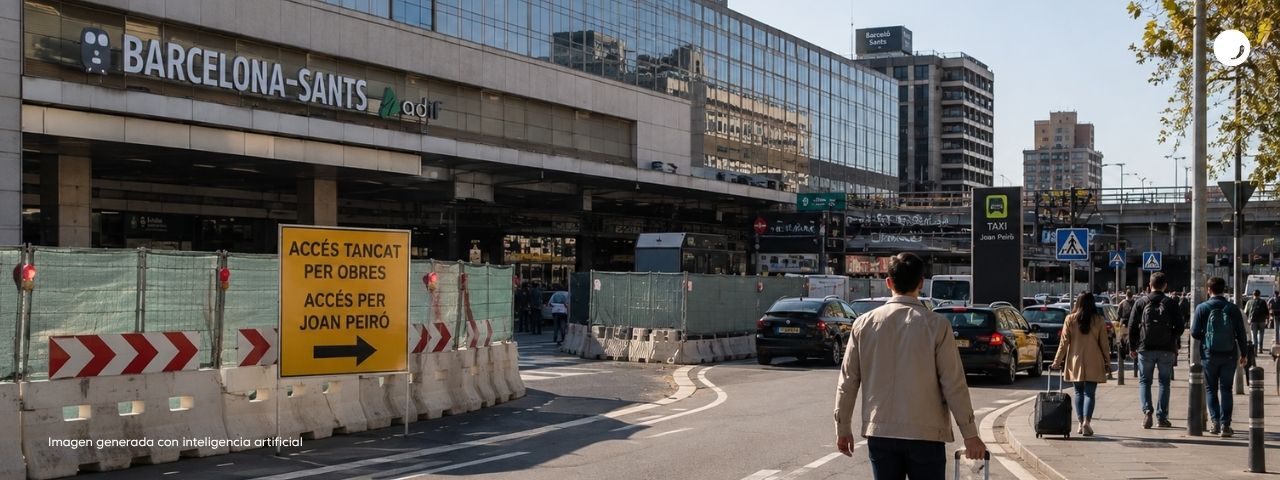
Getting to Barcelona Sants by car has never exactly been a Sunday stroll.
With the works, traffic changes and temporary signage, your GPS may be just as confident as you are and know considerably less.
The good news is that the station is still accessible; the key is knowing which side to approach from, allowing a little more time and not improvising where to leave the car.
And that is what we are dealing with today.
What is changing with the works at Barcelona Sants and why it affects arriving by car
Barcelona Sants is undergoing a comprehensive transformation to expand the station, improve passenger flows and connect it better with the surrounding neighbourhood.
The works are being carried out in phases and affect the building itself, the squares of Joan Peiró and dels Països Catalans, pedestrian routes and traffic around the station.
In practice, this means some routes are being diverted, certain areas have side passages and much of the traffic is concentrated on the sea-facing side of the station.
In addition, the layout may change as the works progress.
That is why, rather than memorising a fixed route, it is worth checking the official information and signage on the day of travel.
What works are taking place and how long they will last
The intervention includes expanding the concourses, waterproofing the roofs, reorganising the accesses and redeveloping the surrounding area.
This is not a random renovation: Sants was designed for a much lower number of passengers than it handles today, and it is expected to reach 74.7 million passengers a year by 2030.
To respond to and accommodate this growth, the station will go from four entrances to six and its interior will be reorganised around two major axes crossing it from side to side.
One of the most important actions in this first phase will be the construction of a new High-Speed departures concourse over part of Plaça dels Països Catalans.
To carry out the works, Adif has confirmed the full closure of the square, currently the main entrance, for both pedestrians and vehicles, at the end of September 2026.
Although alternative routes will be enabled, this change will force people to rethink how to arrive by car, drop someone off or pick up a traveller.
This is not a minor project that will be solved in a few weeks: it is part of the first phase of a 150-million-euro comprehensive renovation that will continue until 2028.
So yes, you will have to deal with it over the coming months.
Which accesses are closing and which ones should be used instead
- Closed from the end of September 2026: the access at Plaça dels Països Catalans, the one facing Avinguda de Roma and the Eixample. The road used to drop off and pick up passengers at the main façade will also disappear.
- Still open and becoming more important: the access at Plaça de Joan Peiró, at the back of the station, next to Passeig de Sant Antoni. The taxi rank remains here and, according to Adif, this is where the quick drop-off and pick-up area will be permanently moved.
- New, scheduled for the end of September 2026: an access on the sea-facing side, next to Parc de l’Espanya Industrial.
- New, scheduled before the end of 2026: an access on the mountain-facing side, next to Carrer Viriat and the bus station, which will connect to a ramp leading to the upper deck and the Barceló Sants hotel.
While these two new accesses are being completed, Adif’s recommendation is to enter and exit only via Joan Peiró or through the side accesses as they come into service.
But keep in mind that, as the phases change, we recommend following the temporary signage.
That last turn your navigator insists on recommending may have been retired months ago.
How to get there depending on where you are coming from
The most convenient route depends on where you are coming from.
These references can help reduce detours, although they should always be adapted to traffic and restrictions on the day:
- If you are coming from the Eixample or Avinguda de Roma: that access disappears. You will have to go around the station towards Joan Peiró or wait for the new mountain-side access next to Viriat to open.
- If you are coming from the Ronda Litoral, Paral·lel or the Poble-sec/Montjuïc area: the new access next to Parc de l’Espanya Industrial will be your most direct option once it opens.
- If you are coming from Gran Via or Carrer de Tarragona towards Llobregat: Joan Peiró and, later, the Viriat access are the most convenient options. This is precisely the area, between Viriat and Melcior de Palau, where aparca&go [LINK INSERTED: https://www.aparcandgo.com/en] is already located, just 2 minutes on foot from the station, allowing you to park before entering the most complicated area.
- If you are coming from the C-32 or the Ronda de Dalt: entering via Diagonal and Numància and continuing towards Viriat can help you avoid the most congested core of the works.
- Dropping someone off, picking them up or taking the train yourself: three different plans
Someone who drops off two suitcases and leaves does not need the same strategy as someone accompanying a traveller or leaving the car for several days.
- If you are only dropping someone off with their luggage, you can no longer rely on the main façade: the Països Catalans road disappears and the quick stop area moves to Joan Peiró.
- To pick up a traveller, the logic is the same as in the previous point, but it is best to wait in a nearby car park until they confirm they have left the station. This way, you avoid driving around or staying longer than allowed in an area designed only for short stops.
- If you are accompanying someone who is travelling and want to wait until they pass the controls, the most practical thing is to avoid the Països Catalans area altogether. With the closure, there will no longer be space to leave the car even for a few minutes, so a nearby car park around Joan Peiró or on the mountain-facing side will be the most reasonable option.
- If you are the one taking the train, the location of the car park matters more than ever: the further it is from the access you are going to use, the more time you will lose because of the works. Prioritise a car park with easy entry and a short, clear route to the station, such as aparca&go, two minutes on foot from the station. Real distance is better judged by walking it with a suitcase than by looking at a map.
How much extra time should you allow?
There is no universal margin, because it depends on the day, the time and how far the works have progressed.
As a practical guideline, add between 20 and 25 minutes to the time you used to calculate before.
Increase that margin to 30 or 35 minutes if you are arriving at rush hour, do not know the area, need to park, are travelling with children or have bulky luggage.
As a reference, on weekdays the busiest time slots around Sants are still from 7:30 to 9:30 and from 17:00 to 20:00, and at weekends, Saturday mornings and Sunday afternoons.
In any case, check real-time traffic before leaving.
What to consider before choosing parking
With the context clear, the next decision is where to leave the car if you are taking a train from Sants.
And here too, there are variables worth analysing before assuming that any nearby option is the right one.
Real proximity, luggage and ease of exit
Being “near Sants” does not always mean getting to the platform quickly.
Road access, the walking route, architectural barriers and the later exit all matter.
With a backpack, five extra minutes are barely noticeable; with suitcases, children or reduced mobility, they can turn into a small expedition.
It is also worth avoiding car parks whose entrance or exit forces you through the most congested points.
That is why you need parking near Sants that solves all these problems.
When parking is worth it and when another option may make more sense
For a quick visit, without luggage and with a good public transport connection, you may not need to take the car all the way to Sants.
But if you are taking a train, travelling with several suitcases, accompanying children or elderly people, coming from outside Barcelona or returning at an inconvenient time, booking parking gives you control and avoids depending on taxi availability or transport combinations.
For trips lasting several days, the daily cost also tends to decrease and you know from the start where the vehicle will be.
It is not just a question of price: it is about removing a last-minute decision in an area where there are already enough variables.
Getting to Sants smoothly during the works starts before you set off
The works will continue to affect the area around Barcelona Sants and routes may change as the different phases progress.
In this sense, what separates those who arrive smoothly from those who arrive stressed is not luck: check the updated accesses, review traffic, calculate a realistic margin and decide where to park before leaving.
At aparca&go, we are right on the side of the station that remains operational during the works, so you can book your space in Melcior de Palau, two minutes on foot from the station, and avoid much of the chaos surrounding the works.
Because the journey should start when you get on the train, not when you start arguing with the GPS.
Reserve your Parking

Barcelona Sea Port Parking
→ View parkingShare article